Lizzy Enders's Relationship with Her Mother
The StaircaseLizzy Enders’s relationship with Mama is defined by closeness, separation, and grief that arrives belatedly. During Mama’s final illness on the journey west, Lizzy hears her describe the vast country as an eternity; after Mama dies, Lizzy cannot feel her presence at the graveside. Only later, in the quiet of evening prayers and in a letter to a friend, does the loss gather its full force. Mama remains present not as a ghostly figure but through remembered habits, advice, and the ordinary life Lizzy can no longer share with her.
Life Together and the Journey West
Mama’s final days are marked by illness and by her distress at the country through which the family travels. Feverish in the wagon, she tells Lizzy that the landscape has no end and calls it eternity. The immensity that leaves the family feeling insignificant also becomes, for Mama, a fearful measure of what lies ahead. At night, she whimpers when coyotes howl; when the party passes an old Indigenous man sitting motionless before a pueblo, she clutches Lizzy’s hand and says that he is waiting for her. These moments show Lizzy close to her mother’s fear, though the child cannot yet understand death as an impending separation.
Mama dies of putrid fever the day after that encounter. Her history gives the journey a particular poignancy: she came from Georgia, endured the war that cost Mr. Enders an arm at the Battle of Buzzard Roost Gap, and then lived in Independence, Missouri, among the family that sheltered her. There she had been active and beloved, tending roses, beginning a women’s literary guild, and baking cakes for church fairs. The life Lizzy remembers in Independence is sharply unlike the isolated burial beneath the Sangre de Cristo Mountains. Mama’s death thus separates Lizzy not only from a parent but from the familiar home and shared routines that had made their closeness tangible.
The Burial and Lizzy’s First Response
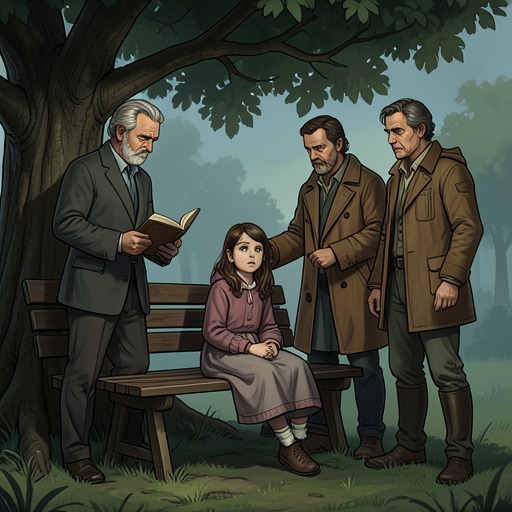
At the graveside, Mr. Enders directs Lizzy to say goodbye while Elinora reads from the Bible. Lizzy stands respectfully, but the gesture does not bring a sense of communion: she does not feel Mama in the buffalo robe, because she believes Mama has already gone from that place. Her wish to be gone too conveys estrangement from the scene rather than a settled understanding of her own grief. She turns away to help prepare supper, an immediate return to the practical tasks of the traveling party.
That night, Lizzy cannot eat because Mama lies buried nearby. Yet her response is not only sorrow. When Mrs. French reminds her that eating and drinking on the Trail are necessary for survival, Lizzy is unsure that she wants to remain alive; seeing Mr. Enders bent over the fire and not eating gives her a reason to do so. She decides she must stay alive for him, remembering that Mama would want it and that he sometimes forgets to eat. Mr. Enders tells the others to leave Lizzy alone, and his defense briefly brings back some of her old love for him. In this first aftermath, care for her father becomes one way Lizzy carries forward what she believes her mother would have wanted.
Grief Delayed and Given Form
At the Catholic school in Santa Fe, evening prayer becomes the time when Lizzy can no longer keep thoughts of Mama at a distance. The novena to Saint Joseph, incense, Latin responses, and chanting initially give her a quiet interval in which to sort through the confusion of school. She thinks of Mama during the day, but those thoughts are often interrupted by the ordinary expectation that she will later tell her mother something or wait for her to discover it. Then comes the realization that there will be no later telling. The permanence of that absence feels blank and almost incomprehensible, so Lizzy pushes the thought aside until the evening service.
When it returns, grief is bodily and overwhelming. Lizzy remembers the lavender Mama used and hears again her instruction not to help Mr. Enders unless he asks, because he needs to feel independent with one arm. The memory moves through the chapel’s incense and music, joining the sensory world of prayer to the intimate particulars of home. Lizzy can cry there without drawing notice; other girls are also prone to tears. The ritual does not erase the loss or settle her questions. Instead, it creates a recurring space in which she can experience what the daytime demands have kept at bay. Her grief follows a pattern of postponement and return, with memory making the absent mother vivid precisely when Lizzy can no longer avoid the fact of her absence.
Memory, Responsibility, and the Continuing Bond
In a letter to Cassie, Lizzy recalls the rides in Independence and the welcome of fresh muffins and warm cocoa after returning home in cold weather. She urges Cassie to be good to her own mother, whatever her sternness about chores. The appeal reveals how loss has changed the meaning of ordinary maternal care: what might once have seemed routine is now something Lizzy longs for and recognizes as irreplaceable. She tries to imagine closing her eyes and returning to the family kitchen, but cannot reconcile the mother she needs in the present with the belief that Mama is in heaven.
That unresolved need is tied to responsibility. Lizzy worries that Mr. Enders cannot carry on alone and fears that, without Mama, she herself will become more unruly. These concerns coexist with her admitted lack of affection for her father at that point; her commitment to him is not evidence that their conflict has disappeared. Rather, Mama’s remembered advice gives Lizzy a specific way to understand his vulnerability and limits the help she should offer. The relationship therefore continues through both tenderness and obligation: Lizzy mourns shared domestic life, summons Mama’s counsel in a changed household, and measures her own endurance against the care her mother once gave. The story’s delayed unfolding of grief makes this bond more than a memory of the dead; it shows Mama’s influence persisting in how Lizzy remembers home, faces absence, and decides whom she must protect.